New paper out: how the ocean bottom friction quietly shapes coastal sea level
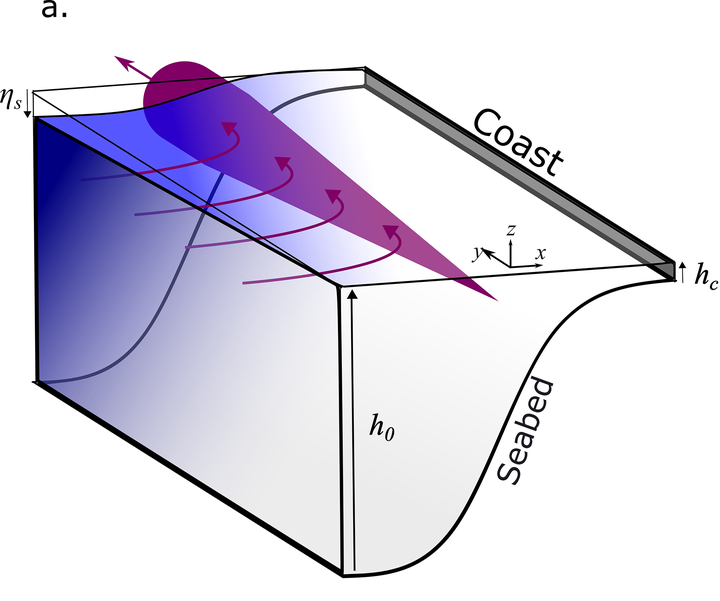 Schematic of the slope geometry. Image credit: Sam Tiéfolo Diabaté.
I’m excited to share our latest paper in Journal of Physical Oceanography, where we dig into a deceptively simple question: 👉 How do changes in the open ocean end up affecting sea level at the coast?
At first glance, you might think it’s straightforward — if the open ocean rises, the coastal sea level rises too. This is true to some extent, but complexities arise when considering regional sea-level changes.
🔍 The problem
In the open ocean, density differences in seawater naturally drive currents and shape steric sea level. But near coastlines, things get complicated:
- The ocean becomes shallow
- Sloping seabeds act as “vorticity” barriers and hinder the mass convergence of density-driven currents
So the key question becomes What actually connects the deep ocean to the coastline?
💡 What we found
Our work shows that friction with the seabed (bottom friction) plays a central — and previously underappreciated — role. Here’s the intuition without the equations:
- Changes in the open ocean (like warming or freshening) set up large-scale “baroclinic” currents
- When those currents hit continental slopes, they can’t just pile water up at the coast. Instead, they turn to flow along the slope with increasing speed.
- These fast currents interract with the seafloor through drag in the bottom boundary layer. This frictional process generates small cross-slope flows.
- The cross-slope flows redistribute water and ultimately adjust sea level on the shelf and along the coast
In other words, the mechanism involves a coupling between density-driven currents, seabed friction and wave-like adjustments along coastlines
🌍 Why this matters and the bigger picture
This matters because coastal sea level is what impacts people, infrastructure, and ecosystems. Our results show that you can’t fully understand coastal sea level from open-ocean processes alone. Slope physics (including friction at the ocean floor, but plausibly involving additional ageostrophic processes) can shape coastal sea level.
This study is quite fundamental but it also opens the door to better interpretations of coastal sea-level observations, improved understanding of boundary processes in the ocean as well as how large-scale open ocean changes propagate to the coast.
📄 I am more than happy to chat about the paper if you’re interested! It is freely available for download at JPO. There is now also a bibliography entry on my website.
I thank my co-authors, Neil Fraser (SAMS, UK) and Gerard McCarthy (Maynooth University, Ireland), as well as the two anonymous reviewers who greatly helped shaping the final version.
S.